Building Forward: The Materials Redefining Durability and Design for the Next Generation
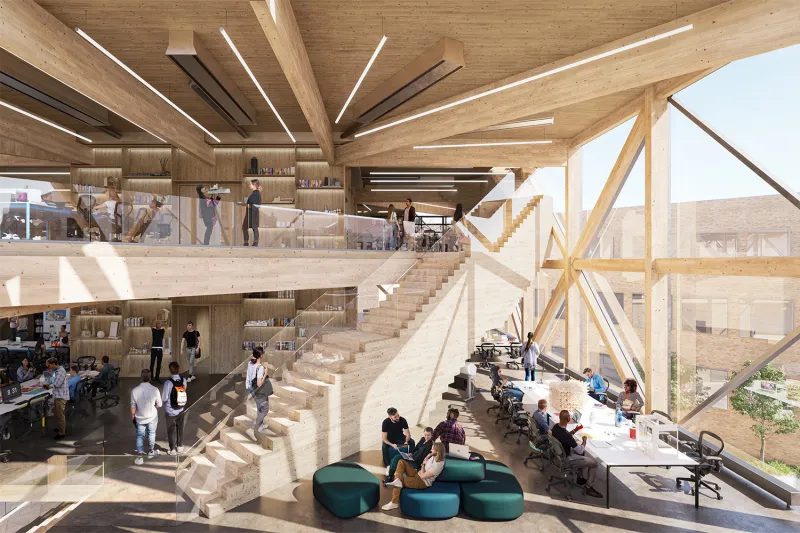
Photo: mass timber sustainable building materials modern architecture interior wood structure, via parametric-architecture.com
Every building is, at its most fundamental level, an assembly of materials. The choices made at that level—structural systems, cladding, insulation, interior surfaces—determine not only how a structure performs on the day it opens, but how it ages, what it costs to maintain, and what it leaves behind when its useful life concludes. For most of the twentieth century, the dominant palette of American construction was remarkably consistent: steel, concrete, glass, and dimensional lumber, supplemented by a rotating cast of synthetic finishes.
That palette is expanding. A convergence of material science research, environmental urgency, and evolving client expectations is introducing a new generation of building materials into serious professional consideration. Some are ancient materials rediscovered and engineered for modern performance. Others are genuinely novel products emerging from laboratory environments and early pilot projects. All of them raise important questions about what responsible, enduring architecture looks like in the decades ahead.
Mass Timber: Structural Ambition Meets Environmental Accountability
No material in contemporary American architecture has generated more sustained professional interest than mass timber—the family of engineered wood products that includes cross-laminated timber (CLT), glulam, and nail-laminated timber assemblies. The reasons are multiple and mutually reinforcing.
From a structural standpoint, mass timber products have achieved performance characteristics that allow them to compete directly with steel and concrete in mid-rise and increasingly high-rise construction. The US has seen a rapid expansion of mass timber projects over the past decade, from academic buildings in the Pacific Northwest to commercial office developments in Chicago and Atlanta. Code frameworks have evolved in parallel: the 2021 International Building Code introduced provisions for tall mass timber construction up to 18 stories, a threshold that would have seemed implausible fifteen years ago.
The environmental case is equally compelling. Wood sequesters carbon during growth and continues to store it when incorporated into a building's structure. Life cycle assessments consistently show mass timber assemblies generating significantly lower embodied carbon than equivalent concrete or steel systems—a consideration that is becoming central to how sophisticated clients evaluate project proposals. Crucially, mass timber is also visually distinctive. Exposed structural wood creates interior environments of warmth and material honesty that occupants consistently respond to positively, a quality that supports both wellbeing and long-term building value.
Hempcrete: Slow Growth, Strong Case
Hempcrete—a composite of hemp hurd (the woody core of the hemp plant), lime binder, and water—has been used in European construction for several decades, but its American adoption has been constrained by regulatory ambiguity surrounding industrial hemp cultivation. The 2018 Farm Bill, which legalized hemp farming at the federal level, removed that barrier, and domestic hempcrete production is now expanding meaningfully.
As a material, hempcrete is not structural in the conventional sense; it is used primarily as an insulating infill within timber-framed assemblies. Its performance characteristics are nonetheless notable. It provides excellent thermal mass, manages moisture vapor effectively, and improves in strength over time as the lime binder carbonates. Its carbon footprint is genuinely negative on a lifecycle basis—the hemp plant sequesters more carbon during growth than is emitted during processing and installation. For residential and light commercial projects where thermal performance and indoor air quality are priorities, hempcrete represents a compelling specification option.
Advanced Composites: Performance Without Compromise
Fiber-reinforced composites—materials combining high-strength fibers such as carbon, glass, or basalt with polymer matrix systems—have been standard in aerospace and automotive manufacturing for decades. Their migration into construction has been gradual but is now accelerating as production costs decline and architectural applications multiply.
The structural advantages are significant. Carbon fiber reinforced polymer (CFRP) components offer tensile strength multiples of steel at a fraction of the weight, with no susceptibility to corrosion. This makes them particularly valuable in coastal and humid environments where conventional steel reinforcement in concrete structures faces accelerated deterioration. Basalt fiber composites, derived from volcanic rock, offer similar corrosion resistance at lower cost and with a more favorable environmental profile than carbon fiber.
For architects, the design implications extend beyond structural efficiency. Composite materials can be formed into geometries that are impractical or prohibitively expensive in conventional materials, enabling expressive cladding systems, complex structural nodes, and custom facade elements that would otherwise require extensive fabrication resources. As digital fabrication capabilities expand across the US construction industry, the relationship between advanced composites and parametric design is likely to deepen considerably.
Recycled Ocean Plastics: Waste Streams as Design Resources
The integration of reclaimed ocean plastic into building materials occupies a different position in the materials conversation—less about structural innovation than about the architecture profession's relationship to material stewardship and circular economy principles. Several manufacturers are now producing cladding panels, tiles, and interior surface materials incorporating verified ocean-recovered plastic, and the category is growing.
The technical performance of these products varies and warrants careful evaluation on a project-by-project basis. What they offer, beyond their material properties, is a legible demonstration of environmental commitment that resonates with clients across commercial sectors—particularly in retail, hospitality, and corporate workplace environments where brand values and built environment align. When specified thoughtfully, ocean plastic materials can serve as focal points that communicate a project's values without dominating its design language.
Transparent Wood and Aerogel Glazing: Rethinking the Window
Two emerging materials deserve particular attention for their potential to transform how architects approach daylighting and thermal performance simultaneously. Transparent wood—produced by removing lignin from wood cells and replacing it with a transparent polymer—transmits diffuse light while providing insulation values substantially higher than conventional glazing. Still largely in research and early commercial production, it represents a genuinely novel addition to the architectural palette.
Aerogel glazing systems, by contrast, are already commercially available in the US market and are being specified in high-performance building envelopes. Aerogel—a silica-based material with extraordinarily low thermal conductivity—can be incorporated into translucent panel systems that provide insulation values approaching opaque wall assemblies while still admitting daylight. For projects with aggressive energy performance targets, this capability has significant implications for envelope design.
What Material Selection Reveals About Design Philosophy
The materials an architect chooses to advocate for, research, and specify are ultimately a reflection of values—about durability, environmental responsibility, aesthetic integrity, and the relationship between a building and its context. At RB Architect, the evaluation of emerging materials is not conducted in isolation from these questions. A material that performs brilliantly on a single metric but fails to contribute to the broader goals of a project—its longevity, its occupant experience, its contribution to a sustainable built environment—is not, in the fullest sense, the right choice.
The next twenty-five years of American architecture will be shaped by decisions being made now, at drawing boards and in specification meetings, about which materials are worth the investment of professional confidence. The most enduring buildings of this era will be those whose material choices reflected not only the best available knowledge, but the clearest sense of purpose.